Beyond the Panels: Why Smart Inverters and LiFePO4 Batteries Are Redefining Solar ROI in 2026
Most Nigerian solar systems fail in the inverter and battery bank — not the panels. Here is the engineering case for hybrid inverters and LiFePO4 storage in 2026, with real load-audit numbers, current Nigerian pricing, and the sizing formula most blogs get wrong.
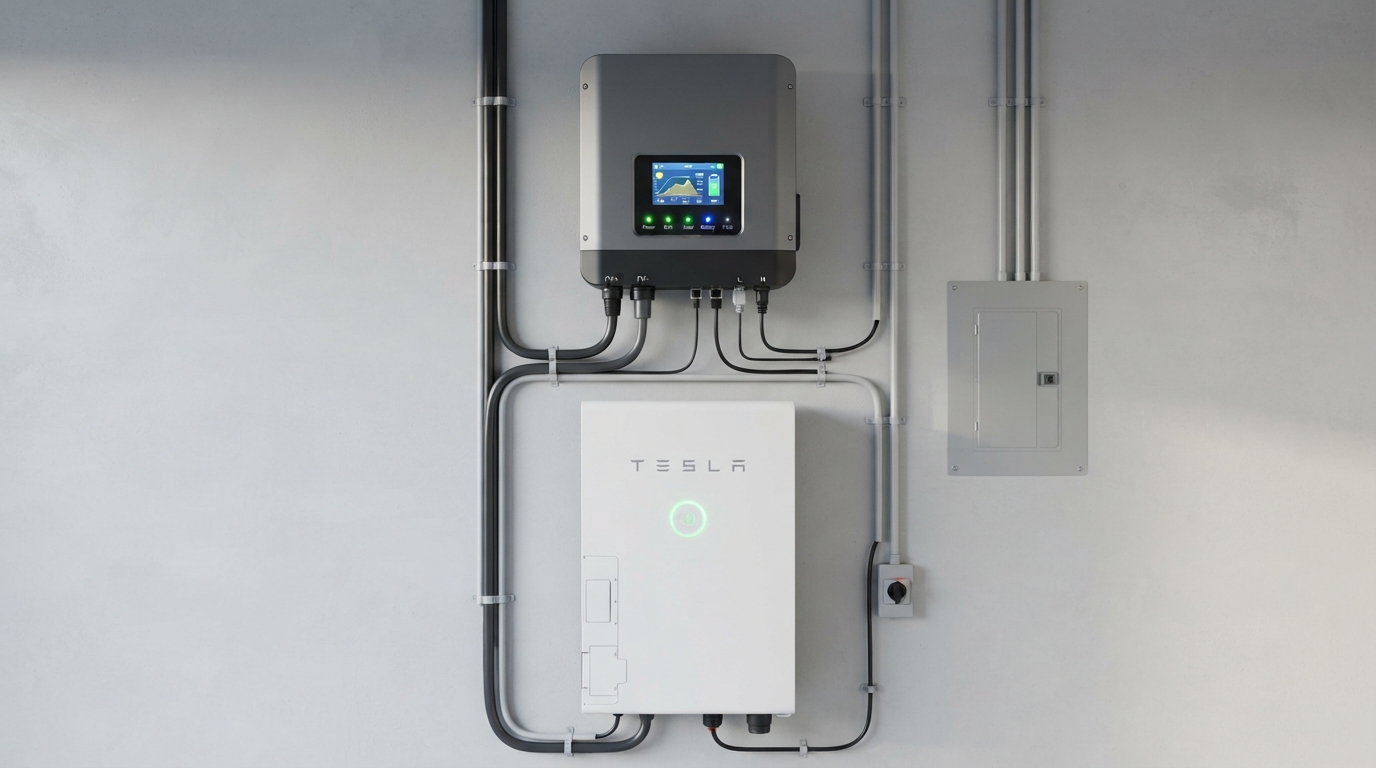
When most people price a solar system, they start with the panels. That is the wrong starting point.
In Nigeria, panels are rarely what fail first. The inverter and battery bank are often the weakest links.
A system built around cheap panels, a generic inverter, and tubular batteries may work for 12–18 months before performance begins to decline. Backup time reduces, the inverter trips under motor loads, batteries become sulfated, and the replacement cost can wipe out every naira initially saved on the panels.
In 2026, the financial value of solar in Nigeria is not determined by how many watts you install on your roof. It is determined by how intelligently your inverter manages energy and how well your battery chemistry performs under demanding environmental conditions.
Two components play a major role in determining the lifespan and return on investment of a solar system: an intelligent hybrid inverter and a LiFePO4 battery bank.
Let us look at the engineering behind both.
- THE DEATH OF THE DUMB INVERTER
Traditional inverters had one primary responsibility: convert DC electricity from solar panels into AC electricity for your appliances.
When the grid failed or electricity demand exceeded the available capacity, many systems simply shut down or entered overload protection. Someone then had to reset the inverter, sometimes in the middle of the night.
Modern hybrid inverters are much more advanced. They serve as the energy management centre of a building.
They monitor electricity consumption, manage available solar power, coordinate battery charging and discharging, and, depending on the model, intelligently distribute power between different sources.
Some advanced models support load management, allowing non-essential appliances to be disconnected when demand becomes too high or battery levels become too low.
They can also manage grid interaction and reduce the impact of certain voltage fluctuations.
However, one feature that matters considerably in Nigerian homes is the ability to handle motor startup currents.
A refrigerator or freezer may consume only 220W during normal operation but require 1,500W–2,500W or more for a brief moment when its compressor starts.
The problem is that many people size their inverters based only on the normal running consumption of their appliances.
When the compressor starts, the sudden power demand can overwhelm the inverter and trigger an overload shutdown.
This is why choosing an inverter based on both continuous power and surge capacity is important.
- BATTERY CHEMISTRY MATTERS: WHY LiFePO4 OUTPERFORMS TUBULAR BATTERIES
Deep-cycle tubular batteries remain a popular option in Nigeria because their initial purchase price is relatively affordable.
However, the purchase price is only one part of the cost of owning a battery.
A 5kWh tubular battery bank and a 5kWh LiFePO4 battery bank do not necessarily deliver the same usable energy or service life.
LiFePO4 batteries generally offer a usable depth of discharge of 80–90% or more, compared with approximately 50% for conventional tubular batteries under typical conservative operating conditions.
They also offer significantly higher cycle life. Depending on the manufacturer, operating conditions and charging practices, LiFePO4 batteries can deliver thousands of cycles before reaching 80% of their original capacity.
Tubular batteries require periodic maintenance, including distilled water replenishment where applicable. LiFePO4 batteries require no internal water maintenance.
LiFePO4 also offers higher round-trip efficiency, meaning less energy is lost during charging and discharging.
Another important advantage is its relatively stable discharge voltage. This helps maintain consistent power delivery under changing loads.
Temperature performance also matters. LiFePO4 has better thermal stability than many other lithium-ion chemistries, although it still requires proper installation, ventilation, temperature management and a suitable battery management system.
Consider a practical example.
A 5kWh tubular battery bank may provide approximately 2.5kWh of usable energy at 50% depth of discharge.
A comparable 5kWh LiFePO4 bank may provide approximately 4–4.5kWh of usable energy, depending on its specifications and operating limits.
This means you get more usable electricity from the same nominal battery capacity.
The difference becomes even more significant when you consider replacement frequency over several years.
A cheaper battery that needs repeated replacement may eventually cost more than a higher-quality battery that lasts longer.
The real question is not simply how much a battery costs today. It is how much usable energy it delivers throughout its lifetime.
- DESIGNING FOR REAL-WORLD LOADS
One of the most important calculations in solar system design is battery capacity.
The formula is:
Daily Storage Requirement (Wh) = (Daily Energy Consumption × Autonomy Days) ÷ (Depth of Discharge × Battery Round-Trip Efficiency)
Many solar calculations consider depth of discharge but overlook battery efficiency.
Ignoring conversion and storage losses can result in an undersized battery bank.
Let us consider a practical example.
Imagine a three-bedroom flat with an estimated daily energy consumption of 7.5kWh.
The household wants one full day of battery autonomy and plans to use LiFePO4 batteries with a depth of discharge of 80% and round-trip efficiency of 95%.
The calculation becomes:
(7,500Wh × 1) ÷ (0.8 × 0.95) = 9,868Wh.
That means approximately 9.9kWh of nominal battery capacity is required under these assumptions.
If each battery module has a nominal capacity of 3.5kWh, three modules would provide 10.5kWh of nominal capacity.
This is why proper system sizing matters. Guesswork can lead to unnecessary expenses or a system that cannot deliver the expected backup time.
There are other engineering considerations that should never be ignored.
Inverter sizing must account for the total running load as well as the startup surge of appliances such as refrigerators, borehole pumps and air conditioners.
Cable sizing and electrical protection are equally important. An undersized cable or improperly selected DC breaker can cause excessive voltage drop, overheating and serious fire hazards.
Temperature must also be considered when designing solar systems in Nigeria. High rooftop temperatures reduce solar panel output, making it important to account for temperature-related performance losses when calculating the required panel capacity.
A good solar installation is not just about connecting panels, batteries and an inverter. Every component must work together within its specified operating limits.
- BUILDING A SOLAR SYSTEM THAT LASTS
Solar panels collect energy, but the inverter manages it and the battery stores it for later use.
A properly designed system must therefore consider the entire energy chain.
Choosing a quality hybrid inverter, investing in suitable LiFePO4 storage, calculating actual household consumption and selecting the correct protection devices can make a significant difference to system reliability and long-term costs.
The economics of solar should not be judged by the initial installation price alone.
What matters is how much you spend over five, eight or ten years, how frequently you replace components and how reliably the system supplies electricity.
A cheaper installation is not always a cheaper system in the long run.
At Tech Services Hub Innovation, we believe solar installation should begin with proper energy assessment and engineering calculations, not guesswork.
That is why we developed our free 16-step Solar Sizing Tool.
It helps users assess their electrical loads, calculate inverter capacity, determine battery requirements, estimate solar panel capacity and evaluate important protection and cable-sizing considerations using Nigerian market conditions.
Before spending money on a solar installation, understand what your home actually needs.
Use our free Solar Sizing Tool and make an informed decision before you buy.
Tech Services Hub Innovation Smart Technology. Digital Innovation. Clean Energy.
Design your own solar system
Use our free 16-step solar sizing tool to size panels, batteries, and inverters for your home or business.